

03 / AdaptDecision System
Tectonic Nexus
A system that turns what people do into what the product does next.
A probabilistic decision layer for what each person sees next. Often, the right decision is to leave them alone.
The question
What should happen next, for this person, right now?
Companies have more data, more models and more tools than ever. Analytics describes what happened. Models predict what might happen. A CRM picks who to message, a recommendation system picks what to show, and LLMs can reason about all of it.
The decision itself is spread across those systems, so the person on the other side gets answers that do not know about each other: an offer from one, a message from another, a recommendation from a third.
What we are building
A decision layer for what each person sees next.
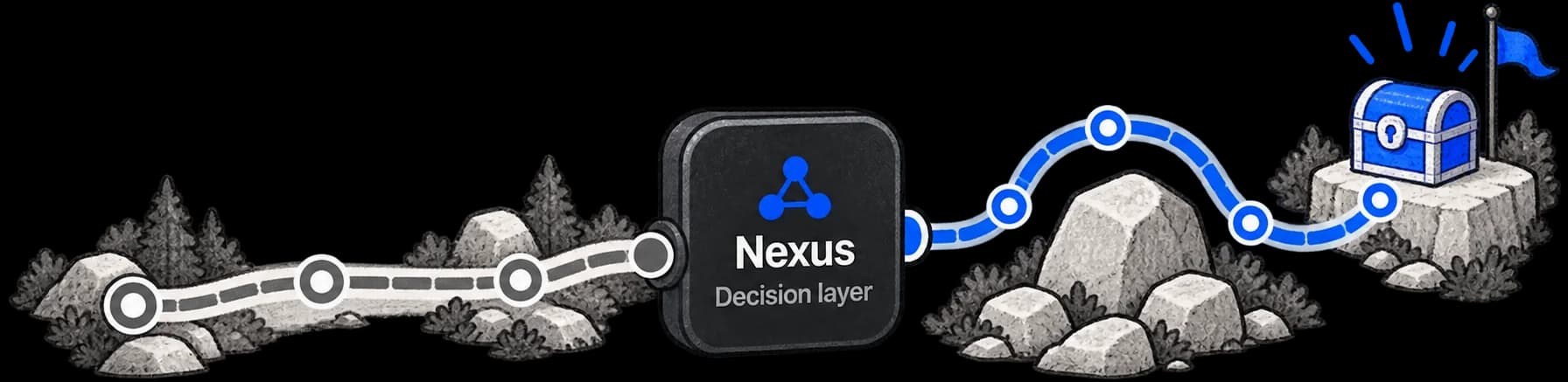
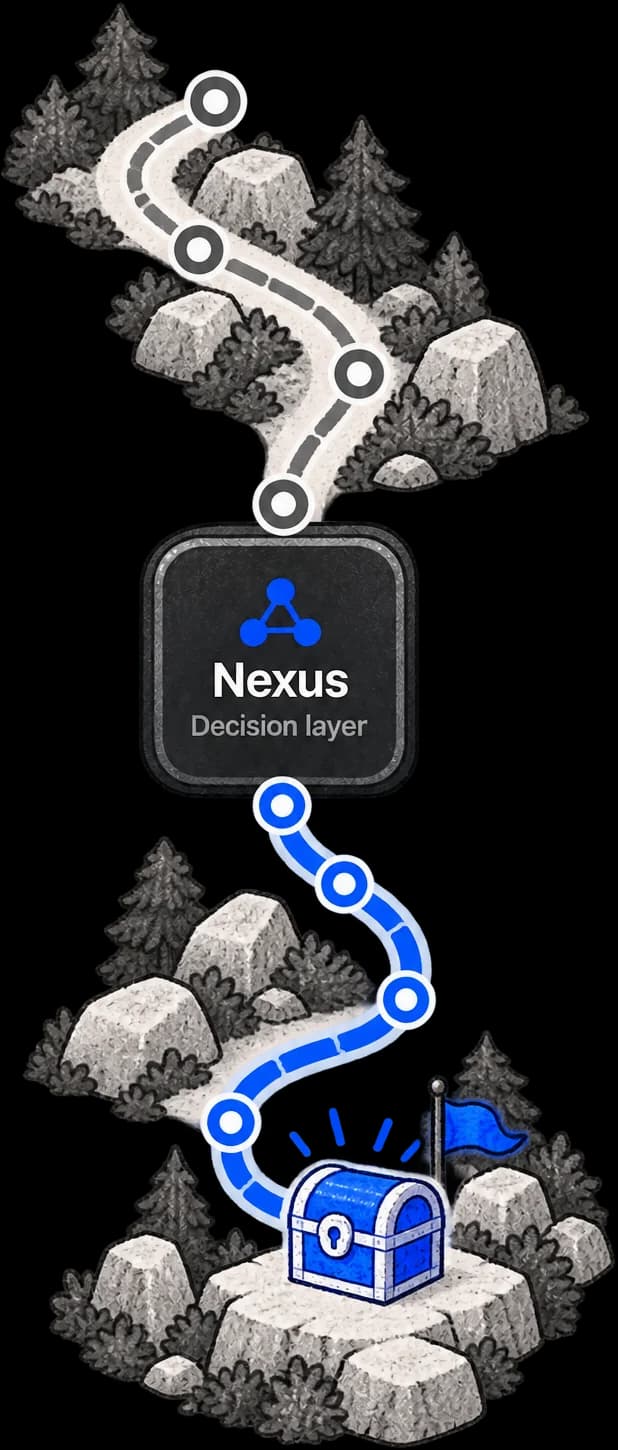
Nexus reads what a person just did, estimates what each possible next step would change for them, and picks one. Often that is to leave them alone. Then it checks whether it was right.
It is built first for iGaming, where the person is a player, and it owns none of the products' logic. It acts only through each product's own approval surface.
- World Model
- A person is one person across every product, not a stranger in each.
- Planner
- Turns an intent into a plan, with its steps, its cost and a way to undo it.
- Policy Engine
- Hard rules that no plan can get around.
- Execution Engine
- Runs each step in the product the person is already in.
Every decision is written to a ledger that can be replayed. A person approves what has not yet earned autonomy, and a playbook earns it on its record.
How it works
A decision without its outcome is unfinished.
Every decision that is carried out returns evidence. Part of each group is held back, so what an action changed for people can be told apart from what they would have done anyway.
- Observe
- State
- Estimate
- Decide
- Act
- Outcome
Nobody lives the journey drawn on a whiteboard. A person opens a game, ignores an offer, comes back two days later. Each of those moments is a small decision, so the path follows the person and not the plan.
The thesis under test
A state, not a segment. A decision, not a prediction.
The same person is curious on a Friday evening and tired on a Monday morning. A segment is assigned once and goes stale, and everyone in it is treated alike. A state is estimated again every time something is observed, so a person is met as they are now.
A prediction says what might happen: this person may leave. It does not say what to do about it. A tired person and a curious one can carry the same risk and need opposite things.
Waiting is on the list. Doing nothing is an action, estimated like the others. Many people come back on their own; leaving them alone spares them a message and the business its cost.
Evidence so far
Built so the thesis can lose.
Nexus is tested on a synthetic world of 10,000 players whose true behavior it never sees, against a strong next-best-action model. Hypotheses and thresholds are written down before each run.
Leaving people alone works, and is aimed. This is what held in every run:
- 61% left alone
- Nexus left most opportunities untouched, and the players it left were the ones who return on their own.
- Retention kept
- No loss against the strong baseline: +0.3 points.
- Every decision replays
- Each one can be audited from its trace.
- No rule broken
- Zero responsible-gaming violations in 125 runs.
One claim is still open: that these decisions are worth more than the baseline's. After three runs the edge is +€1.44 per player, with a 95% interval from −€2.87 to +€5.76, so it is called inconclusive.
All of this is on a synthetic world. None of it is a result on real players.
Nexus and LLMs
Reasoning needs somewhere to land.
Nexus is not a model, and not an LLM product. Models are one stage inside it.
A person or an LLM sets direction a few times: objectives, policies, limits. The software then has to meet that direction thousands of times, for one person and one moment at a time. Nexus makes those small decisions, carries them out and returns outcomes both can learn from.
One rule holds between them: no number in a decision comes from a language model. A model may choose and phrase; the figures come from evidence.
Where it stands
Built, on simulated products.
The loop and the architecture run today on simulated products. Nexus is at research draft 0.1, its paper is in preparation, and the demo is private.
The next step is real players. Until then, the measured results on this site are Tectonic Core's: its test is in the Core case study.
Where it fits
The loop closes here.
Tectonic Play makes behavior visible. Tectonic Core learns from interaction. Tectonic Nexus turns signals into what happens next.
- Play
- Learn
- Adapt
See Tectonic Nexus itself.
Visit Tectonic Nexus